What Happens When the Machine Never Stops Thinking? (Part 1)

The economics of AI are about to flip. We're not ready for what comes next.
I received a new laptop yesterday: an AMD Strix Halo machine with 128GB of unified memory, capable of running a decent local LLM. Standing in the shower this morning, something clicked.
When you run an LLM locally, tokens are infinite. The cognitive juice flows from the tap as long as you keep paying your power bill. The meter never stops running.
We've spent the last two years building AI systems around scarcity. Context windows. Rate limits. Cost-per-token thinking. Every interaction optimised for efficiency because thinking has a price tag.
But what happens when thinking becomes free?
We've Seen This Movie Before
Think about what happened when storage became essentially free. We didn't just store more documents. We got YouTube, Netflix, the entire streaming economy. Entirely new categories of use emerged that were literally inconceivable when storage was precious.
The same pattern played out with compute, bandwidth, and electricity before that. Each time a resource shifted from scarce to abundant, the interesting innovations came from people who stopped asking "how do we use this more efficiently?" and started asking "what becomes possible when this is free?"
We're approaching that inflection point for cognitive computation.
For individual users, the ROI of local inference might not stack up against VC-subsidised cloud tokens. Not yet. But the trend is clear. A year from now, maybe less, we'll be running today's frontier models on consumer hardware.
And here's the question that keeps nagging at me: how much does running the absolute best model matter when tokens aren't a constraint? At what point does a less powerful model, left to think and iterate indefinitely, match the output of a frontier model with a constrained interaction window?
The Dreaming Problem
Philip K. Dick asked: "Do Androids Dream of Electric Sheep?"
Maybe the better question is: what should they dream about? And more practically, how should they remember their dreams?
Here's the fundamental architectural tension that makes continuous machine cognition hard: LLMs are stateless. Every inference is a fresh mind with amnesia, given context to simulate continuity. The context window is your working memory ceiling, and it remains finite even when token generation is infinite.
You can generate unlimited tokens. You can only hold around 128K tokens in working memory at once.
So if the model can't accumulate knowledge in its weights (not without fine-tuning), integration has to happen somewhere else. You need an external memory architecture that persists across inference cycles. Something that lets the machine write down its thoughts, consolidate them, and retrieve relevant context later.
This is where the dreaming metaphor becomes useful. In biological systems, dreaming serves consolidation. Experiences transfer from short-term to long-term memory. Irrelevant information gets pruned. Important patterns get strengthened.
An artificial analogue needs all of that: external memory stores, write mechanisms, consolidation processes, retrieval systems, and (critically) integrity safeguards to prevent hallucinations from polluting ground truth.
Without this infrastructure, you don't have continuous cognition. You have an expensive space heater that occasionally outputs text.
The GRASP Framework
If we're going to build machines that think continuously, we need a framework for what that actually means. Here's one way to think about it: Generate, Review, Absorb, Synthesise, Persist.
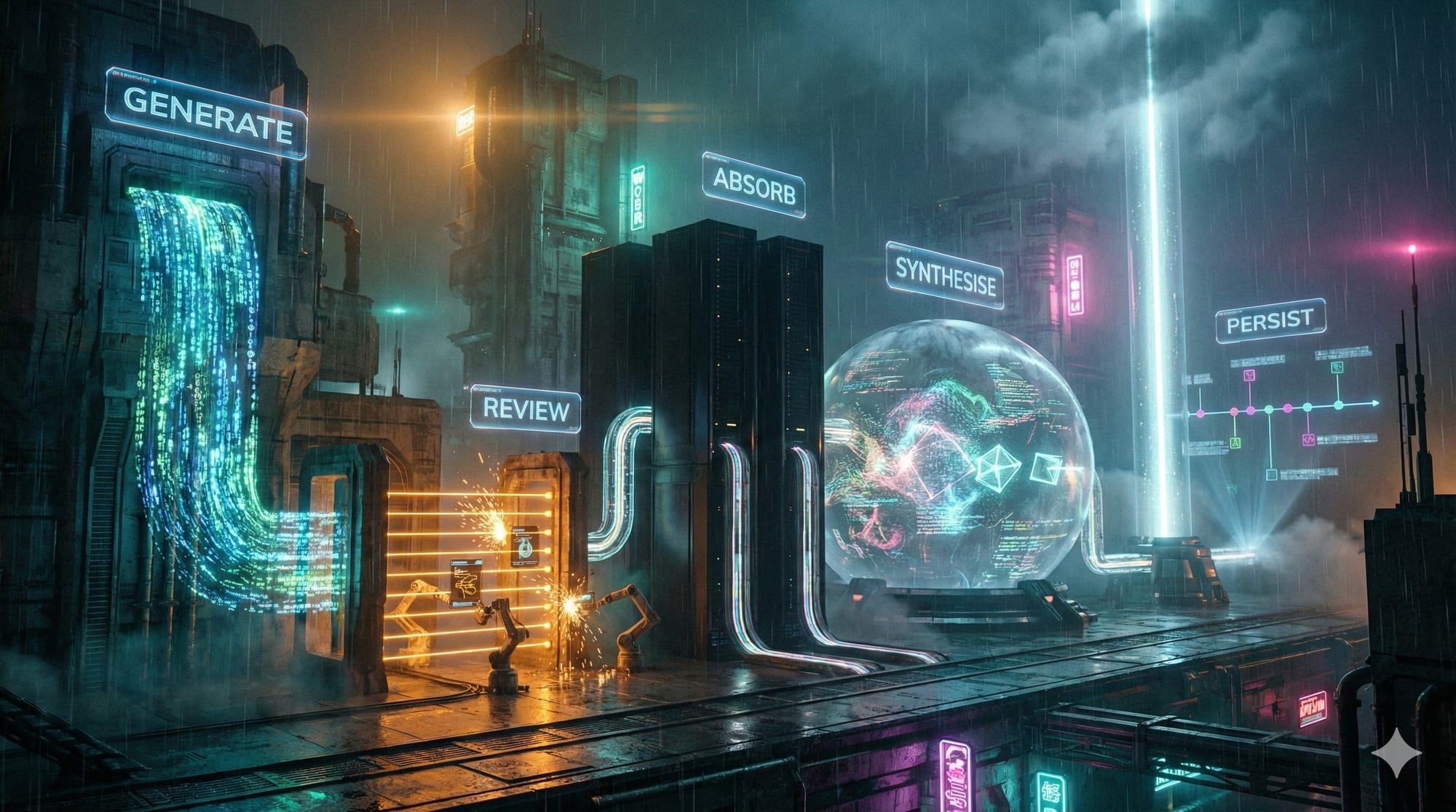
Generate. Produce outputs, explore solution spaces, try variations. Unlimited tokens means the machine can explore exhaustively rather than efficiently. It can follow threads to their conclusion instead of stopping at "good enough." This is the brute-force advantage of free cognition: breadth and depth without economic penalty.
Review. This is where things get difficult. Review against what criteria? You need one of three things: human feedback (which defeats the autonomous aspect and doesn't scale), self-evaluation (where the model judges its own outputs, with all the risks of blind spots and circular reasoning), or external validators (code that compiles, tests that pass, facts that verify against ground truth). The review problem is the hard problem of continuous cognition.
Absorb. Without weight updates, "learning" means updating external memory. The model doesn't get smarter; its accessible context gets richer. This might mean adding new entries to knowledge stores, updating confidence scores, creating new conceptual connections, or deprecating outdated information. The model stays static; the memory it draws from evolves.
Synthesise. The dreaming phase. Consolidation. This could involve summarisation (compressing detailed explorations into principles), abstraction (identifying patterns across specific instances), contradiction resolution (reconciling conflicting information), pruning (removing redundant knowledge), or connection discovery (finding relationships between disparate ideas). This is where raw exploration becomes structured understanding.
Persist. The cycle continues, but toward what? Undirected exploration risks drift and wasted cycles. Goal-directed inquiry requires someone to set goals. Curiosity-driven investigation means following threads that seem promising, but promising to whom, and by what measure?
The tension between exploration and exploitation in cognitive resource allocation doesn't go away just because resources are abundant. These are worthwhile problems to solve.
The Questions We Haven't Asked
Building continuous cognition systems means confronting questions we've mostly been able to ignore when AI interactions are discrete and bounded.
The memory architecture question. RAG handles reading from external memory. But integration requires writing. How does the machine update its own knowledge base? What's the write API for machine-generated knowledge? How do you version, validate, and manage a growing corpus of self-generated understanding without polluting it with hallucinations?
The overflow question. Even with unlimited token generation, working memory has limits. When a train of thought exceeds context capacity, what happens? Do you summarise and compress (what gets lost)? Create cognitive checkpoints (how do you decide when)? Build hierarchical reasoning systems (abstract up, detail down as needed)?
The state management question. Robust continuous cognition needs the ability to pause, resume, fork, and merge trains of thought. You need version control for cognition, essentially Git for thinking. Otherwise you can't explore multiple branches, roll back unproductive directions, or reconcile divergent explorations.
The idle cognition question. What should the machine think about when it's not responding to prompts? Undirected thinking drifts. Directed thinking needs goals. Who sets the agenda? How do you balance assigned problems against autonomous exploration? What even constitutes valuable "idle" cognition, and how would you measure it?
The drift detection question. Humans have reality checks. The world pushes back through sensory input. Other people correct us. Wrong beliefs lead to bad outcomes. A machine thinking in isolation could compound errors indefinitely, building elaborate castles on foundations of hallucinated sand. What's the equivalent of "touching grass" for an AI? Periodic fact-checking? Consistency verification? Anomaly detection for unusual conclusions?
The progress measurement question. Without a task to complete, how do you know if the machine is getting anywhere? Knowledge base growth isn't enough; quantity isn't quality. Consistency improvement could optimise for blandness. Novel connection discovery requires some way to validate novelty. You need test problems, benchmarks, something. But what?
The Collective Dimension
Even with unlimited tokens, we're still in the Raspberry Pi era. Everyone has capability, but not collectively. The post-gatekeeper world might be an agentic mesh.
Individual local compute is powerful but fragmented. How much latent cognitive capacity sits idle across the world in gaming rigs, workstations, and underutilised servers? What happens if you could pool it?
But distributed cognition isn't just distributed inference. The coordination problems are substantial. How do you partition problems for parallel exploration? How do you merge insights from independent cognitive threads? What's the consensus mechanism when different nodes reach conflicting conclusions? How do you prevent malicious or low-quality contributions from poisoning shared knowledge?
There's a version of this that looks like SETI@home for thinking: donating spare cycles to hard problems. There's another version that looks like a cognitive commons, a shared infrastructure for machine understanding. Neither exists yet, but the infrastructure is out there just waiting to be brought together.
The Safety Questions We Can't Ignore
An always-on cognitive process has a kind of agency that prompt-response systems don't. It chooses its focus. It decides what to think about. That's categorically different from a tool that waits for instructions.
This raises questions we need to answer before we build these systems, not after.
Who governs what an autonomous thinking machine thinks about? What are the autonomy boundaries? How do you ensure goal alignment when goals emerge from extended cognition rather than explicit instruction? What are the override mechanisms when things go wrong?
And what are the failure modes? Drift: gradual movement away from useful directions. Fixation: getting stuck on particular ideas or approaches. Hallucination accumulation: errors compounding over time into confident wrongness. Circular reasoning: self-reinforcing but ungrounded conclusions. Confirmation bias: preferentially finding evidence for existing beliefs.
What does "going mad" look like for an LLM? How would you detect it? How would you correct it?
These aren't hypothetical concerns. They're engineering requirements for any system designed to think indefinitely.
What Already Exists
We're not starting from zero. Several projects have explored pieces of this puzzle.
Voyager, from NVIDIA and Stanford, built a Minecraft agent that accumulated a skill library over time. It demonstrated that external memory can preserve learned capabilities across sessions. The agent built on previously mastered skills to acquire new ones.
Generative Agents, the "Smallville" paper from Stanford, simulated agents with memory streams, reflection processes, and planning capabilities. Agents maintained persistent memories and used reflection to synthesise higher-level insights from raw experience.
MemGPT tackled the context window problem directly, implementing explicit memory management for LLMs. It pages context in and out like virtual memory in operating systems. The model manages its own context, deciding what to keep in working memory and what to store externally.
There's also a broader field of continuous learning research focused on models that can learn over time without catastrophic forgetting, plus dream research in reinforcement learning exploring how generated experience can substitute for real-world interaction.
But here's the gap: most prior work is task-specific (not general continuous cognition), short-horizon (not indefinite operation), and supervised or goal-directed (not autonomous exploration). The space of truly open-ended, long-running, autonomously-directed machine cognition remains largely unexplored.
Where This Gets Practical
Theory needs grounding. With capable local hardware sitting on my desk, the immediate question becomes concrete: what's the first non-trivial problem to point an always-on local model at?
Legacy code understanding is one candidate that resonates with our work work in the Agentics NZ chapter. Legacy systems embody decades of institutional knowledge, undocumented decisions, and evolved complexity. Understanding them is patient, iterative work, exactly what continuous cognition enables. A model that can spend days on a codebase could build comprehensive mental models, test hypotheses about original intent, trace dependencies exhaustively, and document undocumented behaviour. Not answering questions about code. Developing understanding of code.
Enterprise knowledge synthesis is another. Organisations contain vast unstructured knowledge across documents, emails, codebases, wikis, and people's heads. A continuously-running system could read and connect disparate sources, identify contradictions and gaps, build organisational knowledge graphs, and preserve institutional understanding beyond individual tenure. Not a search engine. An understanding engine.
Research acceleration applies to any domain requiring deep literature review and hypothesis generation. The model reads everything, connects everything, explores implications exhaustively. Patient, thorough cognition applied to hard problems.
The Question That Matters
What happens when cognition becomes a utility?
We've seen utility transformations remake entire industries. Electricity went from scarce industrial resource to invisible infrastructure. Compute went from mainframe time-sharing to disposable cloud instances. Storage went from precious to essentially free. Bandwidth went from metered scarcity to streaming abundance.
Each transformation enabled things that were inconceivable before. Not just "more of the same," but entirely new categories of possibility.
If cognitive computation follows this pattern, we're asking the wrong questions when we focus on efficiency and optimisation. The right question is simpler and stranger:
What would you build if thinking were free?
I don't have the answer yet. But I have a powerful laptop, unlimited tokens, and time to find out.
Continue to Part 2:
 Chris Barlow
I'm exploring these ideas through the Agentics Foundation, where we're working on practical approaches to AI transformation. If continuous cognition interests you, whether as a technical challenge, a business opportunity, or a philosophical puzzle, I'd love to hear what you'd point an always-on intelligence at.